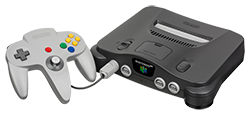
Nintendo 64
The Nintendo 64 (N64) is a home video game console developed and marketed by Nintendo. It was released in Japan on June 23, 1996, in North America on September 29, 1996, and in Europe and Australia on March 1, 1997. It was Nintendo's third major home console, following the Super Nintendo Entertainment System, and competed with Sony's PlayStation and the Sega Saturn in the fifth generation of consoles.
75 games
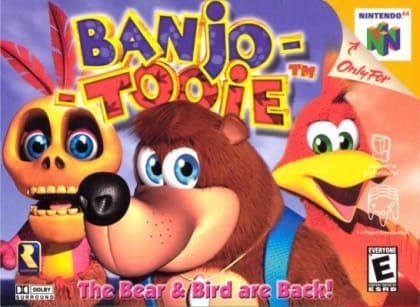
Banjo-Tooie
Banjo-Tooie is a 2000 platform game developed by Rare and published by Nintendo for the Nintendo 64 console. It is the second game in the Banjo-Kazooie series and the sequel to Banjo-Kazooie "Banjo-Kazooie (video game)"). The game follows the returning protagonists Banjo and Kazooie as they attempt to stop the plans of the witch Gruntilda and two of her sisters, who intend to vaporise the inhabitants of the game's island setting. The game features worlds "Level (video games)") significantly larger than those of its predecessor, requiring the player to complete challenges such as solving puzzles, jumping over obstacles, collecting items, and defeating opponents. It also includes a Widescreen format, and a multiplayer mode in which up to four players can compete in several minigames repurposed from the main campaign. Development of the game started in June 1998, directly after the release of its predecessor.
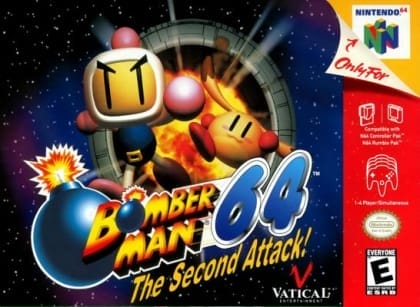
Bomberman 64: The Second Attack!
Bomberman 64: The Second Attack! is a 1999 action video game, the sequel to 1997's Bomberman 64.
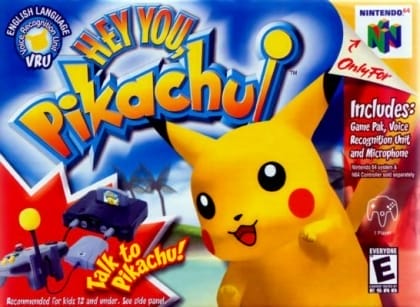
Hey You, Pikachu!
Text is available under the Creative Commons Attribution-ShareAlike 4.0 License; additional terms may apply. By using this site, you agree to the Terms of Use and Privacy Policy. Wikipedia® is a registered trademark of the Wikimedia Foundation, Inc., a non-profit organization. Privacy policy About Wikipedia Disclaimers Contact Wikipedia Legal & safety contacts Code of Conduct Developers Statistics Cookie statement Mobile view Search Search - Toggle the table of contents Hey You, Pikachu! [](http://en.wikipedia.org/wiki/Hey_You_Pikachu#)[](http://en.wikipedia.org/wiki/Hey_You_Pikachu#)[](http://en.wikipedia.org/wiki/Hey_You_Pikachu#)[](http://en.wikipedia.org/wiki/Hey_You_Pikachu#)[](http://en.wikipedia.org/wiki/Hey_You_Pikachu#)[](http://en.wikipedia.org/wiki/Hey_You_Pikachu#)[](http://en.wikipedia.
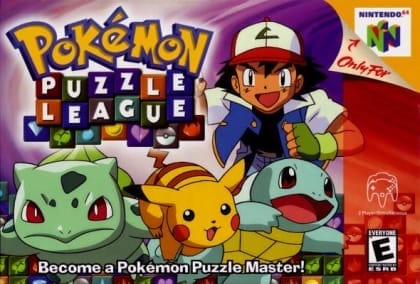
Pokémon Puzzle League
Pokémon Puzzle League is a puzzle video game in the Puzzle League series developed by Nintendo Software Technology and published by Nintendo for the Nintendo 64. Released in North America on September 25, 2000, and in Europe on March 2, 2001, its Puzzle League-based gameplay has a focus on puzzle-based strategy in the game's grid-based format. To advance to new levels, players are required to combat the game's trainers and gym leaders, similar to the ones featured in Pokémon Red, Blue, and Yellow. One of several games based on the Pokémon anime, it features lead protagonist Ash Ketchum, his Pikachu, his companions Brock and Misty, the Kanto Gym Leaders, and other characters from the series. Pokémon Puzzle League received mostly positive reviews from critics. Pokémon Puzzle Challenge, a companion puzzle game, was released for the Game Boy Color in 2000. Re-releases of the game followed in 2008 for the Wii via Virtual Console, and in 2022 on the Nintendo Classics service.
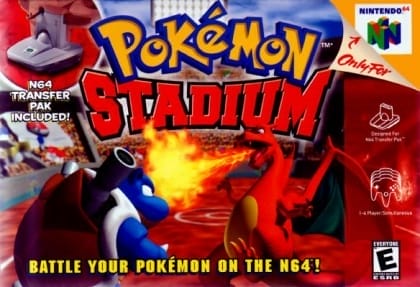
Pokémon Stadium
Pokémon Stadium is a 1999 strategy video game developed and published by Nintendo for the Nintendo 64. The gameplay revolves around a 3D turn-based battling system using the 151 Pokémon from the Game Boy games Pokémon Red, Blue, and Yellow, with several in-game challenges for players to overcome. The game includes four "Cups", each of which is a series of three-on-three Pokémon battles against an ordered lineup of opponents. The "Gym Leader Castle" mode involves battles against several boss opponents who appeared in the Game Boy games. Pokémon Stadium also features mini-games and numerous features available through its compatibility with Pokémon Red, Blue, and Yellow. Using the Transfer Pak accessory that was bundled with the game, players are able to view, organize, store, trade, and battle using Pokémon uploaded from Pokémon Red, Blue, and Yellow. It was the first Stadium title released in Western regions, succeeding the Japan-only 1998 Nintendo 64 release Pocket Monsters Stadium.
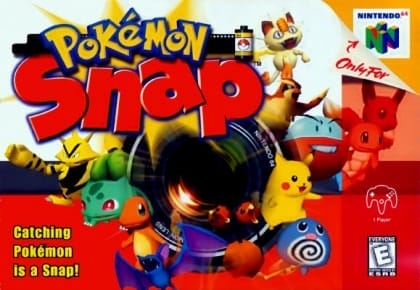
Pokémon Snap
Pokémon Snap is a 1999 photographyvideo game developed by HAL Laboratory and published by Nintendo for the Nintendo 64. It was first released in Japan in March 1999 and was later released in July 1999 in North America and in September 2000 for PAL regions. It is a spin-off "Spin-off (media)") game in the Pokémon "Pokémon (video game series)") series, being one of the first console-based games for it, and featuring many Pokémon rendered for the first time in real-time 3D. The game was re-released for the Wii's Virtual Console in December 2007, for the Wii U's Virtual Console in 2016, and for the Nintendo Classics service in June 2022. Originally announced as a Nintendo 64DD title, the development of Pokémon Snap was moved to the Nintendo 64 due to the 64DD's delays. The gameplay is similar to other first-person games, viewing from the perspective of protagonist Todd Snap as he moves automatically on a rail.
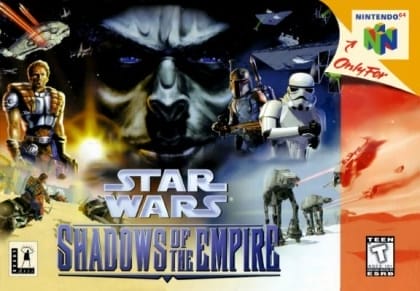
Star Wars: Shadows of the Empire
Star Wars: Shadows of the Empire is a 1996 video game developed by LucasArts and published by Nintendo for the Nintendo 64. It is primarily a third-person shooter, with multiple types of vehicular combat and third-person shooting sequences. A version for Windows was released by LucasArts in 1997. The player controls the mercenary Dash Rendar to help Luke Skywalker and rescue Princess Leia from Prince Xizor. It is part of the Star Wars: Shadows of the Empire multimedia project and takes place between The Empire Strikes Back and Return of the Jedi. Tracks from the multimedia project's soundtrack are in the musical score. The game received mixed reviews from critics. Shadows of the Empire was the third-best-selling Nintendo 64 game for 1997, with more than one million copies sold. Star Wars: Shadows of the Empire plays primarily as a third-person shooter. Players control the protagonist, Dash Rendar.
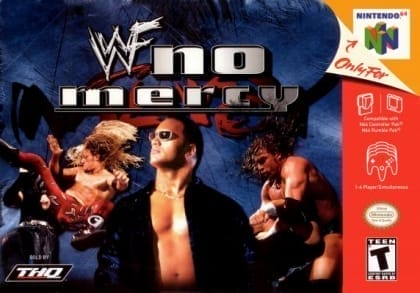
WWF No Mercy
WWF No Mercy is a professional wrestlingvideo game released in 2000 by THQ for the Nintendo 64. It is based on the World Wrestling Federation (WWF, now WWE) and is named after the WWF's annual event of the same name. Developed by Asmik Ace Entertainment and AKI Corporation, No Mercy is the last in a series of Nintendo 64 wrestling games from the companies that started with WCW vs. nWo: World Tour. No Mercy features various improvements over its predecessor, 1999's WWF WrestleMania 2000 "WWF WrestleMania 2000 (video game)"), such as improved graphics, a "Championship" mode that allows players to participate in various branching storylines "Angle (professional wrestling)"), and a more in-depth character creation mode. The improvements made to the game, combined with the series' vaunted gameplay and controls garnered praise from critics upon release. Nevertheless, the game was faulted by some for its blocky graphics, slowdown and the difficulty level of computer-controlled opponents.
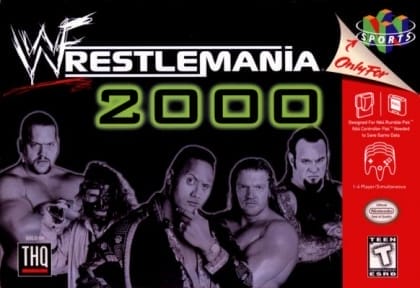
WWF WrestleMania 2000
WWF WrestleMania 2000 is a professional wrestling video game released in 1999 on the Nintendo 64 (N64) console. It was based on the World Wrestling Federation's (WWF, now WWE) annual pay-per-view, WrestleMania. Despite the fact that this game is based upon WrestleMania 2000, the game was released five months prior (and four months prior on the Game Boy Color) to the actual PPV itself, therefore resulting in the game using the stage design from the 1999 event, WrestleMania XV, instead. Released at the height of the WWF's Attitude Era, WrestleMania 2000 was the first WWF game released by THQ. The WWF ended its long relationship with Acclaim Entertainment after witnessing the video game success of its competitor, World Championship Wrestling (WCW), on behalf of THQ. WrestleMania 2000 shares its game engine with the Japan-only release Virtual Pro Wrestling 2: Ōdō Keishō. The game would be followed with a sequel WWF No Mercy in 2000.
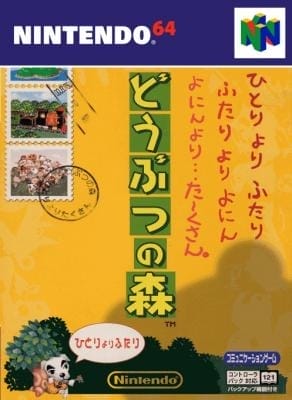
Animal Forest
Animal Crossing, known in Japan as Dōbutsu no Mori, is a social simulation game developed and published by Nintendo. It was first released in 2001 for the Nintendo 64 in Japan, followed by an enhanced port for the GameCube. The GameCube version was localized for North America, Australia, and Europe between 2002 and 2004. It is the first game in the Animal Crossing series. Animal Crossing features nonlinear gameplay in which the player takes up residence in a village inhabited by anthropomorphic animals. The goal is to save money to pay off the mortgage on the player's house by collecting and selling natural materials. The player can engage in everyday life in the village, interact with the animals, attend events, and contribute to the village's development. The western localization replaces Japanese holidays and cultural references with Western ones. Animal Crossing was conceived as a role-playing adventure for the 64DD, with the main action taking place in dungeons.
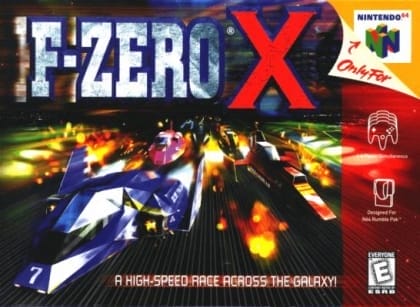
F-Zero X
F-Zero X is a 1998 racing game developed and published by Nintendo for the Nintendo 64. It is the sequel to the original F-Zero (1990), and the first F-Zero game with 3D graphics. It has a steep learning curve and its gameplay experience is similar to that of the original. The F-Zero X Expansion Kit, an expansion pack for the 64DD featuring 12 more tracks and track and vehicle editors, was released in Japan in 2000. F-Zero X introduced the ability to attack other racers, a Death Race mode, and a random track generator called the "X Cup". In the Death Race, the player's objective is to rapidly annihilate or pass the 29 other racers, and the X Cup generates a different set of tracks each time played. Critics generally praised F-Zero X for its fast gameplay, abundance of courses and vehicles, track design, and maintaining a high framerate, although it has been widely criticized for its lack of graphical detail.
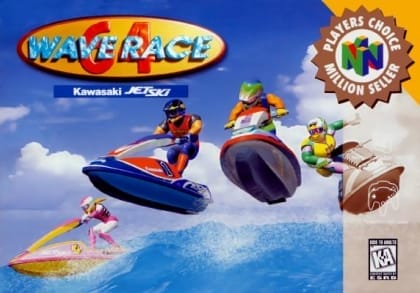
Wave Race 64
Wave Race 64 is a 1996 racing video game developed and published by Nintendo for the Nintendo 64. It is the second entry in the Wave Race series following the 1992 Game Boy game Wave Race. Gameplay involves the player racing on a personal watercraft on a variety of courses while successfully manoeuvring the vehicle around various buoys. A multiplayer mode where two players can compete against each other on a chosen course is also included. The game supports the Controller Pak, which allows players to transfer saved data from one game cartridge to another. The game is presented in a letterboxed 14:9 aspect ratio. Originally referred to as "F-Zero on water", the game was intended to feature high-speed boats with transforming capabilities, but these were ultimately replaced with Jet Skis as producer Shigeru Miyamoto felt that the game would not be differentiated enough from other titles on other systems.
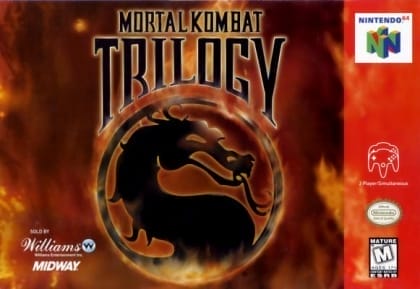
Mortal Kombat Trilogy
Mortal Kombat Trilogy is a 1996 fighting game released by Midway as the second and final update to Mortal Kombat 3 (the first being Ultimate Mortal Kombat 3) for the PlayStation, Nintendo 64, Sega Saturn and PCs. Further versions were also released for the Game.com and R-Zone. It features a similar basic gameplay system and the same story as Ultimate Mortal Kombat 3, but adds characters and stages restored from Mortal Kombat and Mortal Kombat II. New additions to the game included the "Aggressor" bar and the Brutality mechanic. The game was met with mixed to positive reviews upon release.
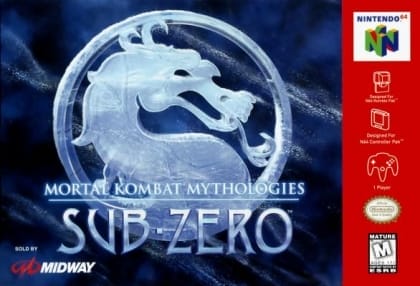
Mortal Kombat Mythologies: Sub-Zero
Mortal Kombat Mythologies: Sub-Zero is a 1997 action-adventure game developed and published by Midway for the PlayStation and Nintendo 64. A spin-off of the Mortal Kombat franchise, it is the first installment not to be a fighting game. Set before the Mortal Kombat, it follows Bi-Han, the elder Sub-Zero, in his quest to find Shinnok's amulet. It also serves as a prequel to Mortal Kombat 4, which was released the same year, introducing characters and story elements that would be used by the fourth main installment. Mythologies is the final game in the series to use digitized actors. The game drew a divisive response from critics, with the PlayStation version considered the superior of the two releases. Praise was directed at the transition from the fighting game genre to action-adventure and the PlayStation version's live-action cutscenes, but the controls and punishing level design received criticism.
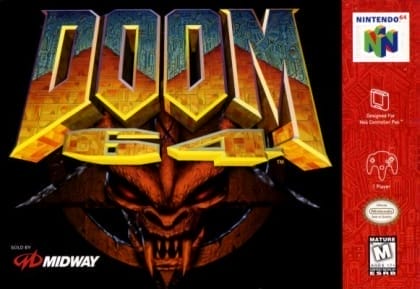
Doom 64
Doom 64 is a 1997 first-person shooter game developed and published by Midway Games for the Nintendo 64. It is the second spin-off in id Software's Doom series "Doom (franchise)") after Final Doom (1996), and the fourth game in the series overall. Doom 64 was developed from 1994 by Midway Studios San Diego under supervision of id Software, the main developer of the Doom franchise, and was tentatively titled Doom: The Absolution. It uses a customized version of the Doom engine, enabling new kinds of level geometry, and dynamic colored lighting. The game features new sprite graphics for weapons and monsters. Doom 64 received positive reviews from critics, who praised its graphics, level design, soundtrack, and atmosphere, although some criticized the lack of new gameplay elements compared to the previous games of the series. It gained a cult following, with several fan-made PC source ports and mods.
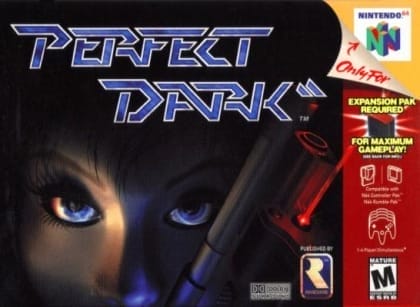
Perfect Dark
Perfect Dark is a 2000 first-person shooter game developed and published by Rare for the Nintendo 64. The first game of the Perfect Dark "Perfect Dark (series)") series, it follows Joanna Dark, an agent of the Carrington Institute research centre, as she attempts to stop an extraterrestrial conspiracy by rival corporation dataDyne. The game features a campaign mode where the player must complete a series of levels "Level (video games)") to progress through the story, as well as a range of multiplayer options, including a co-operative mode and traditional deathmatch settings with computer-controlled bots. As a spiritual successor to Rare's 1997 first-person shooter GoldenEye 007 "GoldenEye 007 (1997 video game)"), Perfect Dark shares many features with its predecessor and runs on an upgraded version of its game engine.
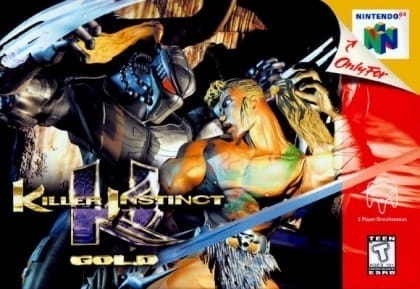
Killer Instinct Gold
Killer Instinct Gold is a 1996 fighting game developed by Rare and published by Nintendo for the Nintendo 64. It is based on the arcade game_Killer Instinct 2. Players control characters who fight on a 2D plane set against a 3D background. Players press buttons to punch and kick their opponent in chains of successive hits, known as combos "Combo (video games)"). Large combo successions lead to stronger attacks and brutal, stylistic finisher moves "Fatality (Mortal Kombat)") underscored by an announcer. Characters—including a gargoyle, a ninja, and a femme fatale—fight in settings such as a jungle and a spaceship. Killer Instinct Gold includes the arcade release's characters, combos, and 3D, pre-rendered environments, but excludes its full-motion video sequences and some voice-overs due to restrictions of the cartridge media format. The Gold release adds a training mode, camera views, and improved audiovisuals.
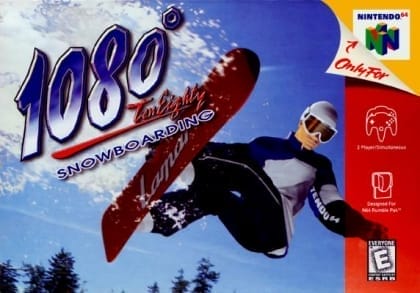
1080° Snowboarding
Commercially, 1080° Snowboarding was a significant success in the United States. According to PC Data, the game sold 817,529 units and generated $40.9 million in revenue by the end of 1998, making it the seventh-best-selling Nintendo 64 game of the year. Over its lifetime, the game sold 1,230,000 units in the U.S. and over 23,000 in Japan. However, it did not surpass the commercial success of the developers' previous game, Wave Race 64, which sold 1,950,000 units in the U.S. and 154,000 in Japan. 1080° Snowboarding was later re-released on the Wii's Virtual Console service in 2008 and on the Wii U in 2016. It was also made available on the Nintendo Classics service on December 7, 2023. 1080° Avalanche, the sequel to 1080° Snowboarding, was released for the GameCube in 2003. Unlike its predecessor, the sequel received mixed reviews.
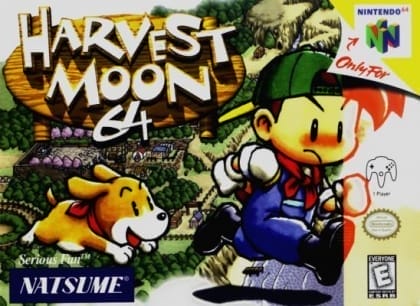
Harvest Moon 64
Harvest Moon 64, released in Japan as Bokujō Monogatari 2 (牧場物語2), is a 1999 farm simulation video game developed by Victor Interactive Software for the Nintendo 64 console. It was published by Victor Interactive in Japan and by Natsume Inc. in North America. It is the third game in the Story of Seasons series (following Harvest Moon GB). The game was re-released on the Wii U in 2017, marking its first release in PAL territories. It was re-released again for the Nintendo Classics service in 2023.
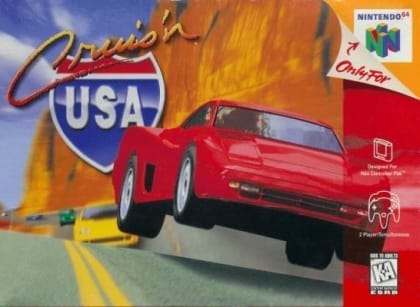
Cruis'n USA
Cruis'n USA is a racingvideo game developed by TV Games Inc. and published by Nintendo. It was first released in arcades in 1994 by Midway Games, with a port to the Nintendo 64 developed by Leland Interactive Media released in 1996. It is the first game in the Cruis'n series, and features races set in locations across the Continental United States. Cruis'n USA is branded as the first release of the "Ultra 64" platform collaboration between Midway and Nintendo, although it was based on the Midway V-unit arcade hardware; again, the unit was different from the Killer Instinct "Killer Instinct (1994 video game)") arcade hardware, which also shared no lineage with the Nintendo 64. The home port was published by Nintendo as part of the deal. The arcade version was critically and commercially successful, drawing favorable comparisons to Sega's Daytona USA. The Nintendo 64 version received poor reviews but was also commercially successful.
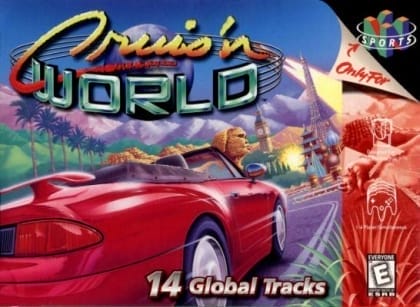
Cruis'n World
Cruis'n World is a 1996 racing game developed by Midway Games and published by Nintendo. It is the sequel to the 1994 arcade racer Cruis'n USA. A port for the Nintendo 64 developed by Eurocom was released in 1998, and was the best received of the Cruis'n ports. Cruis'n World allows players to race on various tracks around the world. The game also features more cars than Cruis'n USA. This game introduced stunts to the Cruis'n series. They served to dodge obstacles, take close curves, and gain extra seconds of time.
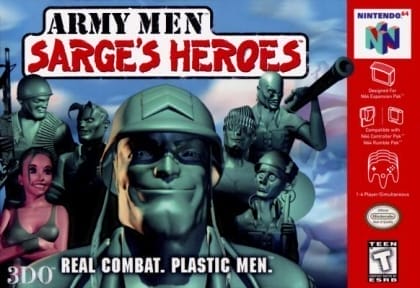
Army Men: Sarge's Heroes
Army Men: Sarge's Heroes is a 1999 third-person shootervideo game and the fourth entry in The 3DO Company's Army Men series, which are based on the green plastic figures of the same name. Its Nintendo 64 and PlayStation versions were developed and published by The 3DO Company. The port for the Dreamcast was developed by Saffire and published by Midway, while another for Microsoft Windows was published by GT Interactive. The primary single-player mode depicts the Green Army, led by Colonel Grimm, fighting against General Plastro's Tan Army, which have found portals to Our World (the human world) that contain useful weapons when fighting in Their World (the world where the plastic soldiers reside). In 3D battlefields of both worlds, the player acts as plastic soldiers of the Green Army completing a variety of missions. In the game's multi-player modes, tan, gray or blue soldiers are options for playable characters. The game features variations of 13 weapons.
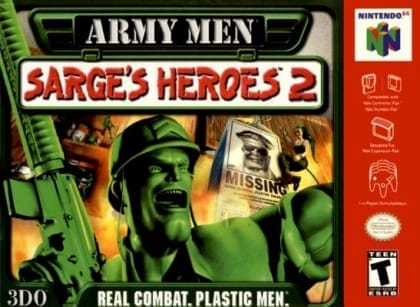
Army Men: Sarge's Heroes 2
Army Men: Sarge's Heroes 2 is the name of two video games published by The 3DO Company in 2000: a third-person shootervideo game developed by The 3DO Company for the Nintendo 64, PlayStation, and PlayStation 2, and a Game Boy Color (GBC) product developed by Game Brains. Both are direct sequels to Army Men: Sarge's Heroes (1999), the GBC release moreso than the 3D home console game, and entries in the Army Men video game franchise (1998–2017). Upon release, critics were burnt out by the Army Men series and were as mixed on Sarge's Heroes 2 as the first game. It was similarly described as a conceptually-good but unfinished game that, with certain improvements and downgrades, had the same pros and cons with controls, graphics, weapons, camera and gameplay as its predecessor. Sarge's Heroes 2 starts where its predecessor left off. It is announced that the capture of Field Marshal Tannenberg will end the war.
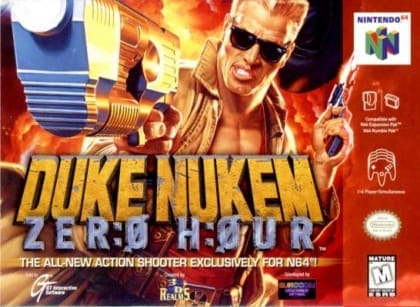
Duke Nukem: Zero Hour
Duke Nukem: Zero Hour is a 1999 third-person shootergame in the Duke Nukem series, developed by Eurocom and published by GT Interactive for the Nintendo 64. The game uses a relatively large 32 megabyte cartridge and can also use the Expansion Pak to improve graphics, though this slows down the frame rate. It features a 4-player split-screen multiplayer mode that uses a first-person view. The plot revolves around time traveling aliens attempting to alter the course of history by eliminating Duke's ancestors. Locations, weapons, items, and clothing correspond to the time period Duke is in. Compared to the comically over-the-top tone used throughout most of the series, this game incorporates more mature plot elements, such as an encounter with Jack the Ripper near the still-fresh murder scene of Mary Jane Kelly in Victorian England and a serious depiction of a future New York devastated by atomic warfare.
Browse our collection of 75 Nintendo 64 retro games, all playable instantly in your browser. No download required. Play classic games online in your browser and save your progress anytime.