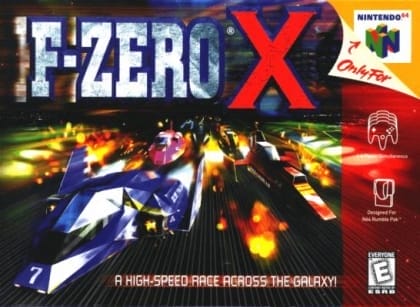
F-Zero X
Play Now
Important Control Tip: If keys are unresponsive after the game loads, please [click on the game window] to activate input focus.
How to Play
How to Play
Press Play Now button to start the Nintendo 64 emulator in your browser.
Control guide merged: use keyboard on PC and on-screen buttons on mobile.
🖥️ PC Controls
| Action | Key (Default) | Description |
|---|---|---|
| D-Pad | ↑↓←→ | Movement control |
| A Button | Z | Confirm / Attack |
| B Button | X | Cancel / Jump |
| Select | V | Select button |
| Start | Enter | Start button |
📱 Mobile Controls
- Movement
- D-pad (left side)
- Action Buttons
- A/B or X/Y/A/B (right side, varies by platform)
- Start / Select
- Center of screen
- Left-Handed Mode
- Swap layout in Control Settings
Mobile Controls: After starting the game, tap the menu in the top-right corner → "Control Settings" to view full key mappings and customize controls.
From Wikipedia, the free encyclopedia:
Source: Wikipedia
About This Game
Gameplay
F-Zero X is a fast-paced futuristic racing video game where 30 competitors race on high-altitude circuits inside plasma-powered hovercars in an intergalactic Grand Prix. Taking place after the original tournament was discontinued for several years due to the extreme danger of the sport, F-Zero X begins after the Grand Prix is brought back with the rules and regulations revised under the same name as the video game. The tracks include hills, loops, tunnels, corkscrews, and pipes. Players can drift into turns without losing momentum by using the control stick and trigger button. The game introduces 26 vehicles, and reprises the 4 from the original F-Zero game. Each has its own performance abilities affected by its size and weight, and a grip, boost, and durability trait graded on an A to E (best to worst) scale. Before a race, players are able to adjust a vehicle's balance between maximum acceleration and maximum top speed. Each machine's energy meter measures the machine's health and is decreased, for example, when the machine hits another racer or the side of the track. This is also a boost meter for manually boosting, usually starting with the second lap of a race.
History
In mid-1996, during Mario Kart 64 development, Shigeru Miyamoto said he planned a sequel to F-Zero for the Nintendo 64. Initially titled "F-Zero 64", Famitsu magazine revealed the project in mid-1997. Tadashi Sugiyama and Shigeru Miyamoto served as director and producer, respectively. Taro Bando and Hajime Wakai served as composers. Several key Wave Race 64 programmers including the lead programmer made up the in-house development team. Developed by Nintendo EAD, it is the sequel to the original F-Zero (1990), and is the first F-Zero installment with 3D graphics. It debuted at the Nintendo Space World event on November 20, 1997, publicly playable for the first time. IGN reported this version was 60% complete and consistently ran at 60 frames per second.
More details about this game can be found on Wikipedia article .
Comments
Log in to leave a comment.
Sign InNo comments yet. Be the first!
Related Games
Antarctic Adventure
Biker Mice from Mars
Need for Speed: Underground 2
Need for Speed: Undercover
Battle Out Run