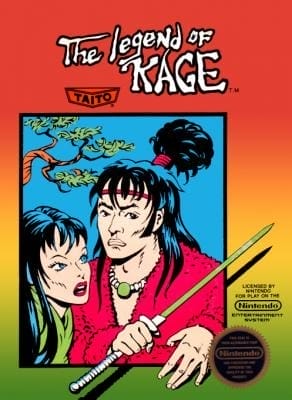
The Legend of Kage
Play Now
Important Control Tip: If keys are unresponsive after the game loads, please [click on the game window] to activate input focus.
How to Play
How to Play
Press Play Now button to start the Nintendo Entertainment System emulator in your browser.
Control guide merged: use keyboard on PC and on-screen buttons on mobile.
🖥️ PC Controls
| Action | Key (Default) | Description |
|---|---|---|
| D-Pad | ↑↓←→ | Movement control |
| A Button | Z | Confirm / Attack |
| B Button | X | Cancel / Jump |
| Select | V | Select button |
| Start | Enter | Start button |
📱 Mobile Controls
- Movement
- D-pad (left side)
- Action Buttons
- A/B or X/Y/A/B (right side, varies by platform)
- Start / Select
- Center of screen
- Left-Handed Mode
- Swap layout in Control Settings
Mobile Controls: After starting the game, tap the menu in the top-right corner → "Control Settings" to view full key mappings and customize controls.
From Wikipedia, the free encyclopedia:
Source: Wikipedia
About This Game
Gameplay
The player takes the role of a young Iga ninja named Kage ("Shadow"), on a mission to rescue Princess Kiri (hime) - the Shogun's daughter - from the villainous warlord Yoshi (ro Kuyigusa) and fellow evil samurai Yuki (nosuke Riko). The player is armed with a kodachi shortsword and an unlimited number of shuriken. Kage must fight his way through a forest, along a secret passageway, up a fortress wall, and through a castle, rescuing her twice (three times in the FC/NES version) in order to win the game. Each time the princess is rescued, the seasons change from summer to fall to winter and back to summer. In home versions, grabbing a crystal ball causes the player's clothes to change to the next level in color and thereby attain certain powers (bigger shuriken or faster speed). If Kage is hit in a home version while in green or orange clothes, he does not die but reverts to his normal red clothes. Cycles repeat after five levels are completed, and play continues until all lives are gone, which ends the game.
History
The Legend of Kage was released by Taito in Japan in 1985, with a European release later in the year, and an American release in January 1986. According to Hisayoshi Ogura, the game's composer, development came after a fast-paced period of game development within Taito, where it eased up around this game. Ogura specifically gave the game's music a distinct Japanese feeling in order for it to fit in better with the setting of the game, and he felt it was a worthy challenge for him to be able to adapt it to the sound hardware. Earlier versions of the game used a sound board based around the MSM5232, the same chip found on synths such as the Korg Poly-800, but an FM version of the soundtrack was also produced given Ogura's experimentation with FM sound at the time.
More details about this game can be found on Wikipedia article .
Comments
Log in to leave a comment.
Sign InNo comments yet. Be the first!
Related Games
The Lucky Dime Caper Starring Donald Duck
The Legend of Zelda: Ocarina of Time
The Legend of Zelda: Majora's Mask
The Legend of Zelda: Oracle of Seasons
The Legend of Zelda: Link's Awakening DX