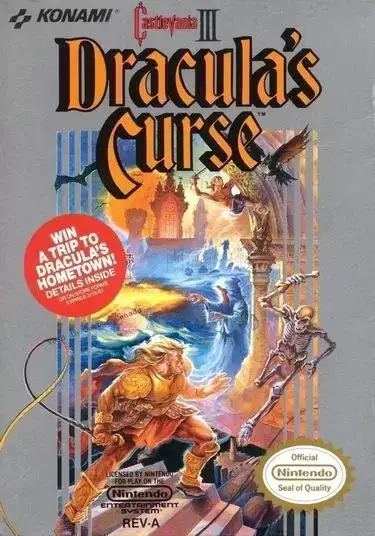
Castlevania III: Dracula's Curse
Play Now
Important Control Tip: If keys are unresponsive after the game loads, please [click on the game window] to activate input focus.
How to Play
How to Play
Press Play Now button to start the Nintendo Entertainment System emulator in your browser.
Control guide merged: use keyboard on PC and on-screen buttons on mobile.
🖥️ PC Controls
| Action | Key (Default) | Description |
|---|---|---|
| D-Pad | ↑↓←→ | Movement control |
| A Button | Z | Confirm / Attack |
| B Button | X | Cancel / Jump |
| Select | V | Select button |
| Start | Enter | Start button |
📱 Mobile Controls
- Movement
- D-pad (left side)
- Action Buttons
- A/B or X/Y/A/B (right side, varies by platform)
- Start / Select
- Center of screen
- Left-Handed Mode
- Swap layout in Control Settings
Mobile Controls: After starting the game, tap the menu in the top-right corner → "Control Settings" to view full key mappings and customize controls.
From Wikipedia, the free encyclopedia:
Source: Wikipedia
About This Game
Gameplay
See also: Gameplay of Castlevania (1986)#Gameplay "Castlevania (1986 video game)") Castlevania III abandons the action-adventure and role-playing elements of its immediate predecessor Castlevania II: Simon's Quest and returns to the platform game roots of the original Castlevania. Unlike the first Castlevania, however, Castlevania III is non-linear: Trevor, the main character, can be assisted by one of three possible companions, and after completing the first level, and at several other points throughout the game, the player is given a choice of two branching paths to follow. The player can obtain multiple endings depending on the choices they make throughout the game. There are two main routes through the game's sixteen stages, which are referred to as blocks and are broken down into several sections. The second stage is an optional excursion for picking up one of the three partner characters, and the main branch occurs part way through the third stage. Each route contains a total of nine stages (ten if the player takes the optional second stage).
History
Besides the different title, Akumajō Densetsu, the Japanese version has several other differences. It contains a specialized VRC6coprocessor chip. The game's audio programmer, Hidenori Maezawa, assisted in the chip's creation. This chip added two extra pulse wave channels and a saw wave channel to the system's initial set of five sound channels. The majority of the music combines the channels to imitate the sound of a synthesized string section. Western versions of the NES did not have the ability to support external sound chips, so the North American release replaced the VRC6 with Nintendo's Memory Management Controller 5#MMC5 "Memory management controller (Nintendo)") (MMC5). The game's music had to be changed by Yoshinori Sasaki to comply with the NES's standard five channels.
More details about this game can be found on Wikipedia article .
Comments
Log in to leave a comment.
Sign InNo comments yet. Be the first!
Related Games
Castlevania
Castlevania II: Simon's Quest
Castlevania: The Adventure
Castlevania Legends
Castlevania II: Belmont's Revenge